The Class of 2030 Admissions Cycle: Why Elite College Admissions Have Reached a New Level of Competition
For students applying to highly selective universities, the Class of 2030 admissions cycle has once again confirmed a reality that families across the world are increasingly recognizing: gaining admission to elite American universities is harder than ever before.
The newest admission statistics from some of the most prestigious colleges in the United States show acceptance rates that continue to remain extraordinarily low. Universities such as Princeton, Harvard, Stanford, MIT, Yale, Columbia, and Duke now regularly admit fewer than 1 out of every 20 applicants. In some cases, the odds are even lower.
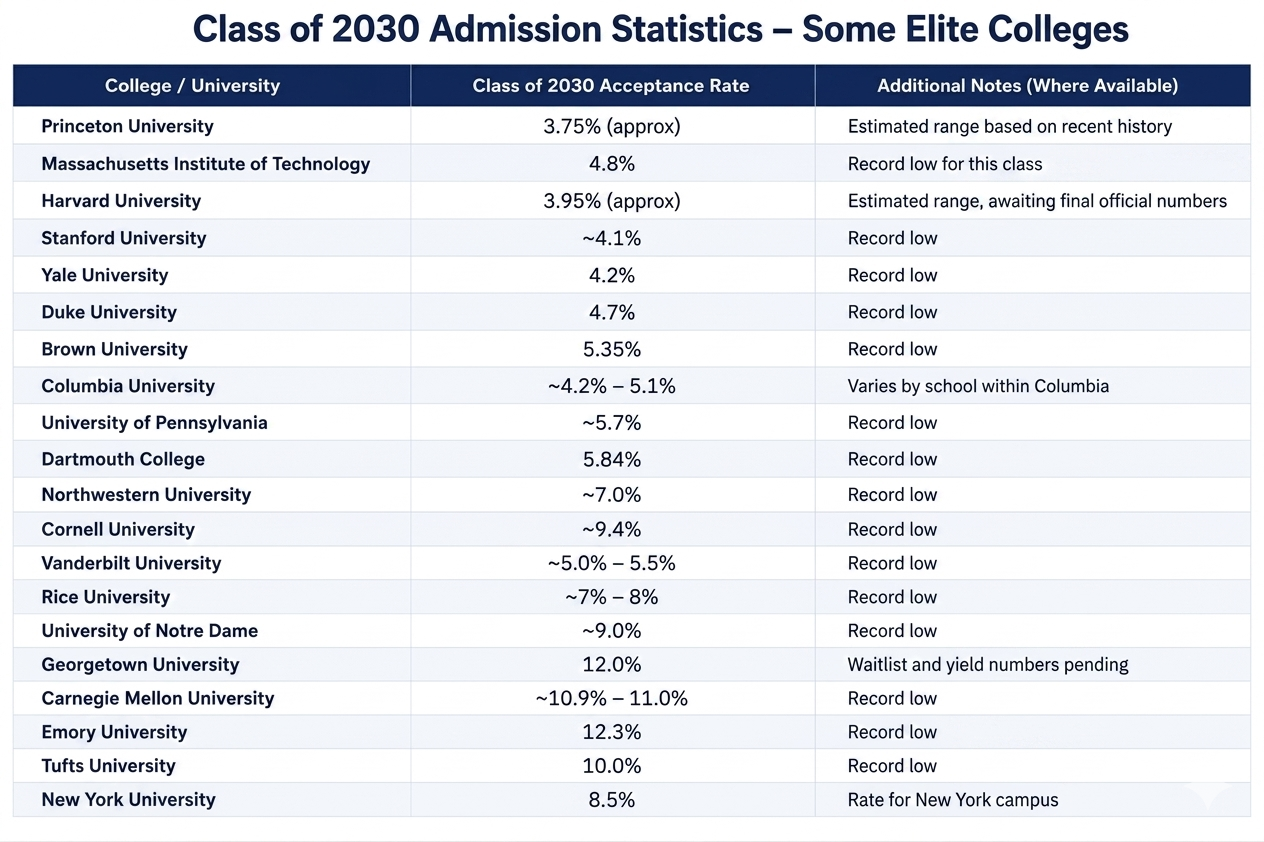
Looking at the data from the Class of 2030, Princeton University’s estimated acceptance rate stands around 3.75%, Harvard University approximately 3.95%, Stanford University around 4.1%, Yale University 4.2%, and MIT roughly 4.8%. These are not simply numbers. They represent one of the most competitive educational environments in modern history.
But what exactly is driving this trend? And more importantly, what should students and families understand about the future of elite college admissions?
Acceptance Rates Alone Do Not Tell the Full Story
One of the biggest misconceptions in college admissions is the belief that acceptance rates alone determine the quality of a university or the strength of an applicant.
In reality, these percentages reflect a much larger shift occurring within higher education.
Over the last decade, applications to elite universities have increased dramatically. Students are now applying to more colleges than ever before. It is not unusual for high-achieving students to submit applications to 20 or even 30 universities. The Common Application system has made this process easier, while social media and online college communities have increased awareness about selective institutions worldwide.
As a result, universities are receiving enormous numbers of applications from exceptionally qualified students.
For example:
- Yale University admitted approximately 4.2% of applicants.
- Duke University admitted around 4.7%.
- Brown University reported approximately 5.35%.
- Dartmouth College admitted roughly 5.84%.
- The University of Pennsylvania remained near 5.7%.
These numbers would have seemed almost impossible just fifteen or twenty years ago.
The Rise of “Perfect Applicants”
Another major factor behind declining acceptance rates is the increasing number of academically exceptional students.
Today, thousands of applicants present:
- near-perfect GPAs,
- high SAT or ACT scores,
- multiple AP or IB courses,
- leadership experiences,
- research projects,
- nonprofit organizations,
- internships,
- national competitions,
- and highly polished application essays.
In previous generations, having strong grades alone could make a student highly competitive. Today, at the elite university level, strong grades are simply the starting point.
This explains why universities like Northwestern (~7.0%), Cornell (~9.4%), Vanderbilt (~5.0–5.5%), and Rice University (~7–8%) continue to reject many highly accomplished applicants every year.
The reality is difficult but important to understand:
Many rejected students are fully capable of succeeding academically at these institutions.
Admissions decisions are no longer based only on academic ability. Universities are now building entire communities and classes with institutional priorities in mind.
The Human Side of Admissions
Families often assume that admissions decisions are entirely objective. However, holistic admissions processes involve many variables beyond numbers.
Universities consider:
- academic rigor,
- writing ability,
- intellectual curiosity,
- leadership,
- institutional fit,
- geographic diversity,
- intended major,
- extracurricular depth,
- personal background,
- and overall class balance.
This means two students with similar academic statistics may experience completely different outcomes.
For example, Carnegie Mellon University, with acceptance rates around 10.9%–11.0%, may admit one student interested in artificial intelligence research while rejecting another student with similar grades applying to a more oversaturated major.
Likewise, New York University, which currently sits around 8.5%, evaluates students differently depending on campus, school, and intended field of study.
Admissions today are highly contextual.
Why Early Decision and Restrictive Early Action Matter More Than Ever
One of the most important trends in modern admissions is the growing advantage associated with Early Decision (ED) and Restrictive Early Action (REA) programs.
Many universities fill a substantial portion of their incoming class during these early rounds.
Students applying early often benefit because:
- they demonstrate strong institutional interest,
- universities can better predict enrollment,
- and the applicant pools are usually smaller.
At institutions like Duke, Brown, Dartmouth, Northwestern, and Vanderbilt, the difference between Early Decision and Regular Decision acceptance rates can be significant.
This does not mean students should apply early without careful thought. Early Decision programs are binding and should only be used when students are fully committed financially and academically.
However, understanding admissions strategy has become increasingly important in today’s environment.
The International Student Perspective
International students face an even more competitive process.
Many elite American universities receive applications from extraordinarily talented students across Asia, Europe, the Middle East, Latin America, and Africa. In many cases, international applicants compete for a smaller number of available seats compared to domestic students.
This is especially true for students seeking financial aid.
As competition increases globally, universities are also looking for students who can contribute unique perspectives and experiences to campus communities.
Academic excellence alone is often not enough.
Students increasingly need:
- compelling personal narratives,
- authentic extracurricular engagement,
- strong communication skills,
- and meaningful long-term interests.
Prestige Is Not Everything
One of the healthiest lessons families can learn from these statistics is that rejection from an elite university does not define a student’s future success.
Some of the most successful professionals, entrepreneurs, physicians, engineers, and researchers in the world graduated from universities outside the ultra-selective top 10 or top 20.
The obsession with rankings sometimes causes students to overlook excellent universities that may actually provide:
- stronger mentorship,
- smaller class sizes,
- better scholarship opportunities,
- less academic pressure,
- and more personalized career development.
Universities such as Emory (12.3%), Georgetown (12.0%), Tufts (10.0%), and Notre Dame (~9.0%) remain highly respected institutions with outstanding academic outcomes.
Students should focus not only on prestige, but also on fit, opportunity, affordability, and long-term goals.
What Students Should Actually Focus On
As admissions become more competitive, students often ask:
“What can I do to stand out?”
The answer is not creating artificial activities solely for applications.
Instead, students should focus on:
- developing genuine academic interests,
- pursuing meaningful extracurricular involvement,
- building strong writing skills,
- challenging themselves academically,
- and demonstrating long-term commitment to their goals.
Authenticity matters more than many families realize.
Admissions officers read thousands of applications every year. They can often recognize when activities are performed purely for résumé building rather than genuine passion.
The strongest applications usually reflect intellectual depth, maturity, and consistency over time.
Final Thoughts
The Class of 2030 admission statistics demonstrate that elite college admissions are entering an era of unprecedented selectivity.
With Princeton near 3.75%, Harvard around 3.95%, Stanford near 4.1%, Yale at 4.2%, and many other elite universities remaining below 10%, the process has become extraordinarily competitive even for exceptional students.
However, students should remember something very important:
These numbers do not measure human potential.
An admissions decision reflects institutional priorities at a specific moment in time, not a student’s intelligence, future success, or worth.
The goal should never be simply gaining admission to the most selective university possible.
The real goal is finding a university environment where a student can grow academically, professionally, and personally while building a meaningful future.